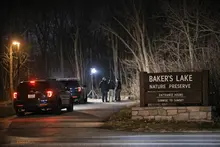
A day after a federal enforcement action spilled onto a Palatine street, about 100 people gathered outside the village’s police headquarters to demand answers — not just about one officer’s split-second choices, but about where local authority ends and federal power begins. Sanitized local reporting provided to us says the Oct. 28 demonstration followed an incident in which a Palatine officer assisted federal agents during an arrest, triggering questions about whether the help ran afoul of Illinois restrictions on local participation in civil immigration enforcement.
Tensions at the Station
According to sanitized local reporting provided to us, Palatine officers encountered three federal agents attempting to take a person into custody late Monday morning after police responded to a disturbance. As onlookers gathered, a Palatine officer moved between the agents and the crowd to keep the peace. When the person being detained remained noncompliant and tensions rose, the department says the officer decided to help “stabilize” the situation, issuing commands in Spanish and briefly holding the person’s right arm while agents finished cuffing the left. The department framed the move as a safety measure amid an agitated scene; protesters questioned whether it amounted to local participation in a federal immigration arrest.
What the Law Says
At the center of the controversy is the Illinois TRUST Act. The law prohibits local police from detaining individuals solely on the basis of federal immigration detainers or administrative warrants — a guardrail meant to separate local policing from civil immigration enforcement and to preserve cooperation with immigrant communities, according to the National Immigrant Justice Center. While the statute draws a bright line around detentions based only on civil immigration paperwork, it leaves police with their ordinary public-safety responsibilities when immediate threats or disturbances arise.
That line is exactly where debate has sharpened in the region. Some law-enforcement leaders argue the TRUST Act can complicate collaboration in situations they believe implicate public safety, as reported by Hoodline. Immigrant-rights advocates counter that the law’s limits are necessary to avoid blurring roles and undermining community trust, the National Immigrant Justice Center notes.
Who Lives in Palatine — and Why It Matters
Palatine is home to roughly 66,500 residents, data from Data USA shows. It’s also one of the region’s more internationally rooted suburbs: about 23.8% of residents are foreign-born, according to Data USA. The community’s racial and ethnic makeup — approximately 61.4% White, 19.6% Hispanic, and 12.9% Asian — underscores its diversity, according to Census Dots.
Those numbers help explain why a brief moment of local assistance to federal agents can reverberate widely. The TRUST Act’s goal of maintaining a clear division of roles is not abstract here; it maps onto whether residents feel safe reporting crime, showing up as witnesses, or calling police for help — outcomes the law was designed to protect, according to the National Immigrant Justice Center.
The Key Questions
What happened on that sidewalk matters, but what it means legally depends on details that aren’t yet public. Sanitized local reporting provided to us says the officer’s contact was brief and focused on “stabilizing” the arrest. Still, critical uncertainties remain:
- Was the individual being detained on a judicial warrant or a separate arrestable offense, or was the detention based solely on an immigration detainer or administrative warrant? The latter scenario would implicate the TRUST Act’s core prohibition, according to the National Immigrant Justice Center.
- Did the Palatine officer’s actions amount to active participation in a federal immigration arrest — such as taking or transferring custody — or were they limited to crowd-control and safety? That distinction could affect legal exposure and policy compliance, the National Immigrant Justice Center notes.
Answers may lie in body-camera recordings, incident reports, and radio logs that have not yet been released publicly.
A Community Asks for Answers
Protesters’ core demand is clarity: what do Palatine officers do — and not do — when federal agents make an arrest in town? Practical steps outlined by advocates and legal groups offer a roadmap to defuse uncertainty and rebuild trust:
- Launch an internal review and publicly document the officer’s involvement, including whether a judicial warrant was present, as recommended by the National Immigrant Justice Center.
- Conduct a legal compliance audit to confirm alignment with the TRUST Act and publish the findings, the National Immigrant Justice Center advises.
- Clarify departmental policy on interactions with federal immigration authorities — especially during on-scene encounters — and train officers accordingly, per recommendations from the National Immigrant Justice Center.
- Invite community participation through open forums and make space for questions from immigrant residents in a village where nearly one in four people is foreign-born, data from Data USA shows. Community groups can also file public-records requests for body-camera footage and reports to establish a shared factual baseline, steps aligned with guidance from the National Immigrant Justice Center.
The Stakes for Trust and Safety
The debate now unfolding in Palatine mirrors a broader regional tension over balancing public safety with the need to keep local policing distinct from federal immigration enforcement. Law-enforcement leaders who worry that the TRUST Act can complicate cooperation in fluid situations, as Hoodline has reported, should still find common ground with residents who want consistent, lawful policies and transparent communication. Those are not opposing goals.
What happens next will hinge on facts that can be verified and policies that can be clarified. If Palatine officials make public the documents that show whether a judicial warrant existed, and if they articulate clear limits on officer involvement when federal agents operate in town, the village will be better positioned to turn a fraught moment into a constructive reset. In a community as diverse as Palatine, where nearly a quarter of residents are immigrants according to Data USA and where racial and ethnic diversity runs deep per Census Dots, transparency is more than good governance — it’s a public-safety strategy. The next few weeks should tell whether the village leans into that approach by releasing records, answering the unresolved legal questions under the TRUST Act outlined by the National Immigrant Justice Center, and convening the community to decide, together, where the line should be drawn.