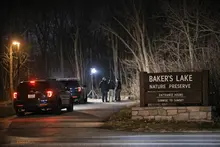
A busy Barrington intersection fell silent Monday afternoon after a semi-truck rolled onto its roof and its driver was left heavily trapped, forcing firefighters into a prolonged rescue and a medical helicopter evacuation. Police say dashcam video shows an SUV turning into the truck’s path at Barrington and Dundee roads, a collision that shut the crossroads for hours on October 8.
What happened
Barrington police and firefighters were called at approximately 2:35 p.m. on October 8 to the intersection of Barrington Road and Dundee Road for a crash with injuries, according to the Barrington Police Department. The vehicles involved were a 2016 Acura MDX and a 1998 Western Star 5900 semi-truck hauling a dump trailer, Police Chief David Daigle said.
Dashcam video obtained by Lake and McHenry County Scanner showed the semi-truck traveling eastbound on Dundee Road proceeding through the intersection on a solid green light. The Acura, traveling north on Barrington Road, attempted a right turn onto eastbound Dundee Road and “failed to come to a complete stop” before pulling directly in front of the truck, according to Chief Daigle’s account of the video and the police investigation. The semi struck the driver’s side of the Acura and veered off the roadway to the south, rolling over onto its roof. The impact spun the Acura, whose back left corner struck the truck again before the SUV was forced up an embankment and into a telecommunications box, Chief Daigle said.
Both vehicles sustained significant damage, police said.
Emergency response
Fire crews found the semi-truck driver, a 55-year-old North Chicago man, heavily entrapped in the cab and suffering apparent serious but non-life-threatening injuries, according to the Barrington Fire Department and Chief Daigle. Extrication took about 1.5 hours as firefighters stabilized the overturned truck and cut the driver free.
A helicopter landing zone was established at nearby Ron Beese Park at Cornell Avenue and Rotary Drive. A LifeNet medical helicopter landed in the soccer field and waited roughly 20 minutes until extrication was complete. Paramedics transported the driver by ambulance to the landing zone, where he was transferred to the flight crew and airlifted to Advocate Condell Medical Center in Libertyville, according to Chief Daigle.
The Acura’s driver, James D. Schmit, 84, of Venice, Florida, was transported by ambulance to Endeavor Health Northwest Community Hospital in Arlington Heights, Chief Daigle said.
Traffic fallout and investigation
The crash triggered heavy delays in all directions. Officers completely shut down the intersection to protect the rescue and allow for an on-scene reconstruction by the Lake County Major Crash Assistance Team (MCAT). Barrington Road reopened around 8:15 p.m., while eastbound Dundee Road remained closed longer for continued investigation and cleanup, according to village officials. Crews from Ernie’s Wrecker Service used a heavy wrecker to upright and remove the semi-truck and to clear rock spilled from the dump trailer. Village officials said all roads were open again by about 7:15 a.m. the following day.
Following the initial investigation, police cited Schmit for disobeying a red traffic signal and failure to reduce speed to avoid a crash. He is scheduled for an initial court hearing on November 18, according to the Barrington Police Department.
Why this corner matters
Barrington is a village of roughly 10,400 residents where a handful of arterial roads carry commuter traffic across town, according to the U.S. Census Bureau and local records. Intersections that mix heavy trucks and larger passenger vehicles like SUVs have been a persistent safety concern. Data from Barrington traffic safety analysis reports indicate 45 crashes involving SUVs and trucks at village intersections over the last five years, many occurring during the afternoon rush.
Transportation safety analyses note that collisions between through-moving heavy trucks and turning vehicles can produce severe outcomes because of the truck’s mass and rollover risk, and because afternoon congestion narrows the safe gaps drivers must judge. Human factors can add complexity: while age alone does not determine fault, safety specialists caution that older drivers may face challenges such as slower reaction times or difficulty judging speed and distance—factors that can elevate risk at complex, high-volume intersections. Those observations are general and not presented as a causal finding in this case.
What could help prevent this
A synthesized review of local safety proposals suggests a package of engineering and behavioral strategies that could reduce the likelihood and severity of right-turn/through conflicts at Barrington and Dundee roads:
- Engineering controls, traffic engineers recommend: dedicated right-turn signal phases; upgraded, high-visibility signage and pavement markings; adjusted signal timing and clearance intervals to accommodate heavy vehicles; improved sightlines by trimming vegetation or removing obstructions; and evaluation of truck-routing options during peak hours.
- Enforcement and education: targeted peak-hour enforcement at high-risk intersections; consideration of red-light enforcement where authorized; community campaigns emphasizing right-turn stopping and yielding rules; outreach through senior centers offering voluntary refresher courses and driving assessments; and collaboration with commercial trucking firms on intersection safety practices.
- Emergency-response readiness: formalizing pre-designated helicopter landing zones like Ron Beese Park; regular multi-agency drills focused on heavy-vehicle extrication; pre-staging of specialized heavy-rescue tools; and standardized triage-to-transport protocols to accelerate decisions on air medical activation. These measures are aimed at shaving critical minutes when entrapment delays transport.
Those recommendations reflect safety priorities identified by traffic engineers and emergency-response specialists in the compiled materials and are distinct from the police findings on causation in Monday’s crash.
As the legal process moves forward for the cited driver and MCAT completes its reconstruction, the scene at Barrington and Dundee underscores a familiar regional challenge: fast-moving through traffic meeting turning vehicles at a crowded suburban crossroads. The question now, for a village accustomed to afternoon gridlock and heavy-vehicle corridors, is how to turn the lessons of this rollover into concrete changes that make the next peak-hour drive a little safer—for truckers, SUV drivers, and everyone in between.