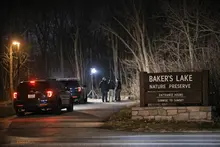
Two ice fishermen who fell through the ice on the Fox River in Port Barrington were pulled from the water and brought to shore by the Wauconda Fire District within six minutes, then transported to Advocate Good Shepherd Hospital in Barrington in stable condition, according to Daily Herald reporting.
The men had walked onto a channel of the Fox River while ice fishing when the ice gave way, leaving them about 50 feet from shore, the Daily Herald reported. Firefighters reached them and completed the rescue quickly, after which both were evaluated for cold exposure and taken to the hospital.
Wauconda Fire District Division Chief Mike DaValle used the incident to underscore how quickly conditions can shift. “No ice is ever completely safe,” said DaValle, division chief and public information officer for the Wauconda Fire District. Daily Herald He also warned that recent temperature swings and warm weather can weaken ice even when “the surface appears solid,” the newspaper reported.
That caution aligns with statewide guidance that emphasizes both thickness and conditions such as current, weather and variability across a single body of water. The Illinois Department of Public Health advises that ice should be at least four inches thick to support skating and at least eight inches of clear ice for snowmobiling, while also warning that running water and recent warming can undermine ice strength regardless of how it looks, according to the Illinois Department of Public Health.
Authorities also emphasize preparedness and avoiding isolation on winter outings: IDPH recommends not going onto ice alone and having rescue tools—such as a rope, ladder or blankets—available, along with ongoing attention to whether ice is uniform rather than relying on appearance, according to the Illinois Department of Public Health.
While the Port Barrington rescue focused attention on immediate winter hazards, another debate playing out in the Barrington area has centered on governance and growth—specifically, proposed statewide zoning changes advanced by Gov. JB Pritzker that would affect issues including minimum lot sizes, residential density and parking requirements.
Suburban officials have argued those proposals could reduce municipal authority over land-use decisions that traditionally are handled locally. “strip away that local control,” said Paula McCombie, Mayor of South Barrington. Daily Herald
Barrington-area leaders have also raised concerns about how state mandates could alter development patterns in communities known for larger lots and lower-density neighborhoods. “destroy our town,” said Brian Cecola, Village President of Barrington Hills. Daily Herald
State Rep. Martin McLaughlin, who represents parts of the northwest suburbs, similarly criticized the concept during the same public discussion described by the newspaper. “It’s just a bad idea on its face,” said McLaughlin. Daily Herald
In their comments, officials tied their objections to broader concerns about loss of local governance over zoning decisions, potential effects on community character and the possibility of increased infrastructure costs. The statements also reflected a view that zoning choices play a role in protecting established neighborhoods and property values, as framed in the Daily Herald coverage.
The twin focus on safety and development has particular resonance in Barrington, a community with a well-established residential identity. Data from Data USA estimates Barrington’s 2023 population at 11,049, with a median age of 43.1 and a median household income around $150,714—figures that reflect a relatively affluent suburb where residents closely track both public safety conditions and policy decisions that could reshape neighborhoods.
For local emergency responders, the Port Barrington rescue served as a timely example of how quickly routine winter recreation can turn dangerous, particularly on waterways where current and shifting temperatures can create weak spots. For municipal leaders, the zoning debate has centered on the degree to which state rules should set housing and development parameters that communities have historically determined through local planning and zoning processes.